Astronomers Find Out What Happens to Rocky Planets That Wander too Close to Their Stars

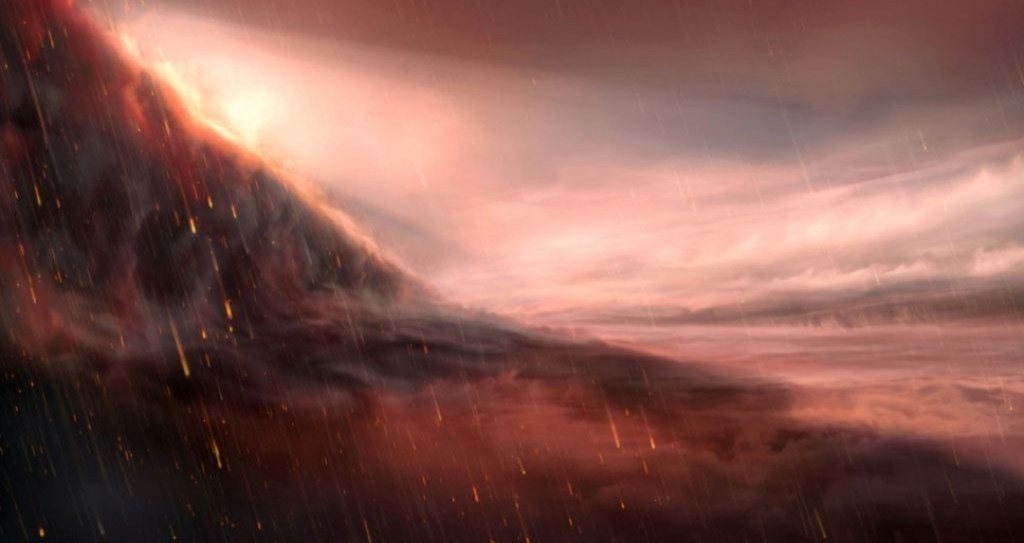
This artist’s illustration shows the fiery exoplanet WASP-76b. Previous study shows the planet rains iron it’s so hot. Now astronomers have detected barium in its atmosphere. Image Credit: ESO/M. Kornmesser

The massive Kepler survey found a treasure trove of exoplanets. But in all that wealth they found three anomalies: what appeared to be rings of dust surrounding stars where planets should be. They were rocky planets in the process of being obliterated. And a team of astronomers that found a way to use these gory sites to understand some of the most mysterious and hard to detect planets in the universe.

We currently know of about 5,000 exoplanets in the galaxy. This represents only a small fraction of the estimated 1 trillion worlds within the Milky Way. But even though we’ve made great strides, we have exceptional difficulty finding one particular class of exoplanet: the small, rocky ones. Our techniques rely on transits. When an exoplanet crosses in front of the face of the star, it causes a small dip in brightness from our point of view. But if the planet is too small, the change in brightness isn’t large enough for us to detect, and so the small planets, roughly the size of the Earth and smaller, remain hidden from us.


But recently a team of researchers recently pointed out that some anomalies in the Kepler data may be a blessing in disguise. Among the data returned from Kepler includes what appears to be rings of dust and debris surrounding a star. Previous researchers had concluded that these are rocky planets in the process of obliteration. They are worlds that got too close to their parent star, and the heat of that star is boiling them alive.

The team of researchers released a paper detailing simulations of how this process could unfold. They found that these small worlds are caught between two extremes. Because they orbit closely to their parent star, they are almost certainly tidally locked, which means that only one side of the planet faces the star at all times. The other side is permanently locked in night. The day side gets blasted to such a degree that instead of a crust it just has a thin shell of pure magma. But the other side is so cold that the rocky crust remains in place.


The night side cools down the planet while the day side heats it up. The astronomers found that there is only a very narrow window where we can observe such situations. If a planet is too big or the star is not bright enough, then it does not evaporate enough material for us to detect it in something like Kepler. However if the planet is too small or the star is too intense, the entire planet obliterates in a short enough time that we are unlikely to see it in a random sample of stars.

Only certain special cases can lead to a ring of debris large enough and visible enough for us to see it. Going from this the astronomers estimate that for every star in the galaxy there is roughly one planet the size of the Earth or smaller.
Mehr

Scientists Find ‘Evidence’ of Another Universe Before Our Own

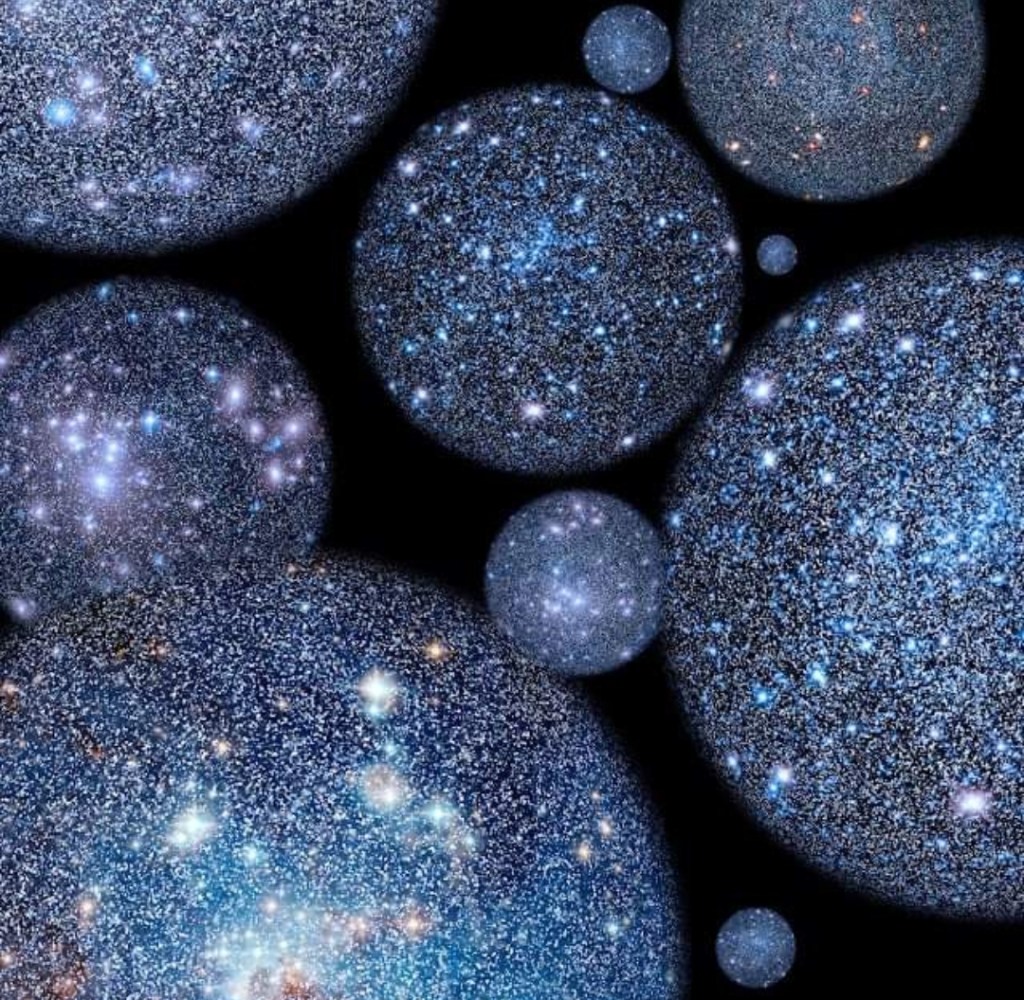
Picture of how the Multiverse could look like according to scientists and philosophers…


According to New Scientist, the concept is based on something known as conformal cyclic cosmology (CCC). What it means is that our universe, rather than beginning with a single Big Bang, goes through continual cycles of Big Bangs and compressions.

While the vast majority of the cosmos would be annihilated from one cycle to the next, these scientists claim that some electromagnetic radiation may survive the recycling process. Their findings have been published on arXiv.

“What we claim we’re seeing is the final remnant after a black hole has evaporated away in the previous aeon,” University of Oxford mathematical physicist Roger Penrose, a co-author on the study and co-creator of CCC theory, told New Scientist.

The evidence is presented in the form of “Hawking points,” which are named after the late Stephen Hawking. He hypothesised that black holes would release Hawking radiation, which Penrose and his colleagues claim may travel from one universe to the next.

They believe Hawking points might arise in the cosmic microwave background, which is the leftover radiation from the Big Bang (CMB). On the CMB map, hawking spots would appear as rings of light known as B-modes.


Previously, it was considered that these aberrant locations in the CMB were created by gravitational waves or interstellar dust. However, Penrose and his colleagues believe their theory may give an exciting response, and one such Hawking point may have already been discovered by the BICEP2 project, which aims to map the CMB.

“Though seemingly problematic for cosmic inflation, the existence of such anomalous points is an implication of conformal cyclic cosmology (CCC),” the team wrote in their paper.

“Although of extremely low temperature at emission, in CCC this radiation is enormously concentrated by the conformal compression of the entire future of the black hole, resulting in a single point at the crossover into our current aeon.”

The recycling universe idea is not without debate. The majority of our data imply that the universe’s expansion is accelerating, with the cosmos not being dense enough to condense back into a single point and expand again – a notion known as the Big Bounce.

A speeding black hole is birthing baby stars across light years


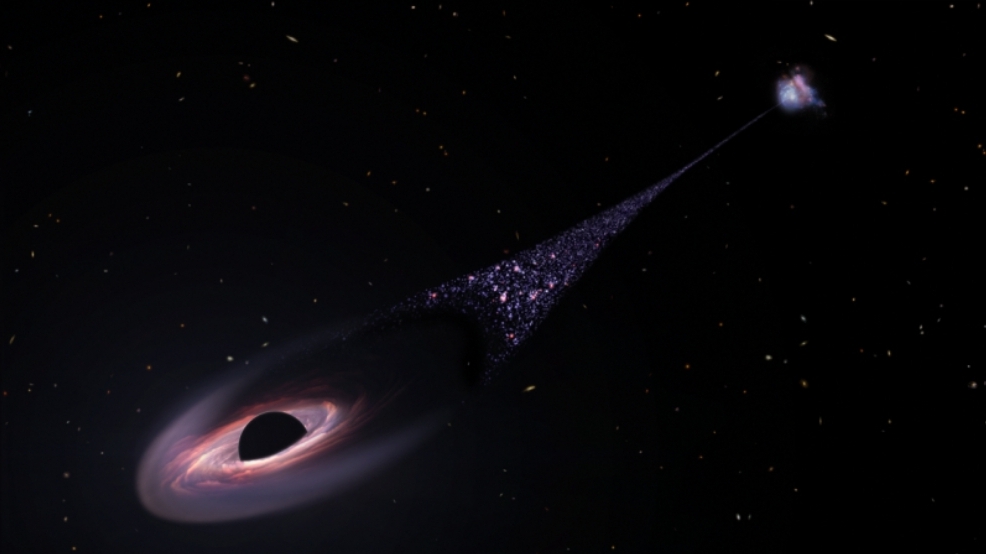
Astronomers accidentally discovered with the Hubble Space Telescope a runaway black hole doing weird, unprecedented things. Credit: NASA / ESA / Leah Hustak (STScI) illustration

Astronomers think they have discovered a supermassive black hole traveling away from its home galaxy at 4 million mph — so fast it’s not doing what it’s notorious for: sucking light out of the universe.

Quite the opposite, possibly. Rather than ripping stars to shreds and swallowing up every morsel, this black hole is believed to be fostering new star formation, leaving a trail of newborn stars stretching 200,000 light-years through space. Pieter van Dokkum, an astronomy professor at Yale University, said as the black hole rams into gas, it seems to trigger a narrow corridor of new stars, where the gas has a chance to cool.

How exactly it works, though, isn’t known, said van Dokkum, who led research on the phenomenon captured by NASA’s Hubble Space Telescope accidentally. A paper on the findings(Opens in a new tab) was published last week in The Astrophysical Journal Letters.

“What we’re seeing is the aftermath,“ he said in a statement(Opens in a new tab). „Like the wake behind a ship, we’re seeing the wake behind the black hole.”

Black holes are some of the most elusive things in outer space. The most common kind, a stellar black hole(Opens in a new tab), is often thought to be the result of an enormous star dying in a supernova explosion. The star’s material then collapses onto itself, condensing into a relatively tiny area.

Mehr