Researchers discover new ultra strong material for microchip sensors

by Delft University of Technology
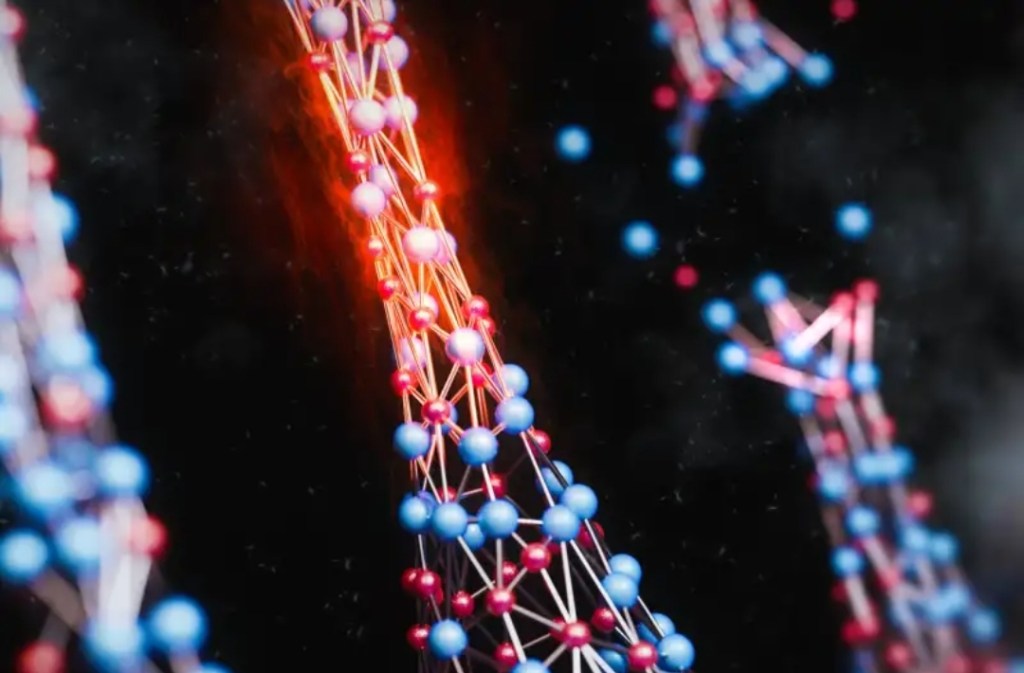
Cover of Advanced Materials with an artist impression of amorphous silicon carbide nanostrings testing to it’s limit tensile strenght. Credit: Science Brush

Researchers at Delft University of Technology, led by assistant professor Richard Norte, have unveiled a remarkable new material with potential to impact the world of material science: amorphous silicon carbide (a-SiC). Beyond its exceptional strength, this material demonstrates mechanical properties crucial for vibration isolation on a microchip. Amorphous silicon carbide is therefore particularly suitable for making ultra-sensitive microchip sensors.

The study is published in the journal Advanced Materials.

The range of potential applications is vast. From ultra-sensitive microchip sensors and advanced solar cells, to pioneering space exploration and DNA sequencing technologies. The advantages of this material’s strength combined with its scalability make it exceptionally promising.

Ten medium-sized cars
„To better understand the crucial characteristic of ‚amorphous,‘ think of most materials as being made up of atoms arranged in a regular pattern, like an intricately built Lego tower,“ explains Norte. „These are termed as ‚crystalline‘ materials, like for example, a diamond. It has carbon atoms perfectly aligned, contributing to its famed hardness.“

However, amorphous materials are akin to a randomly piled set of Legos, where atoms lack consistent arrangement. But contrary to expectations, this randomization doesn’t result in fragility. In fact, amorphous silicon carbide is a testament to strength emerging from such randomness.

The tensile strength of this new material is 10 GigaPascal (GPa). „To grasp what this means, imagine trying to stretch a piece of duct tape until it breaks. Now if you’d want to simulate the tensile stress equivalent to 10 GPa, you’d need to hang about ten medium-sized cars end-to-end off that strip before it breaks,“ says Norte.

Nanostrings
The researchers adopted an innovative method to test this material’s tensile strength. Instead of traditional methods that might introduce inaccuracies from the way the material is anchored, they turned to microchip technology. By growing the films of amorphous silicon carbide on a silicon substrate and suspending them, they leveraged the geometry of the nanostrings to induce high tensile forces.

By fabricating many such structures with increasing tensile forces, they meticulously observed the point of breakage. This microchip-based approach not only ensures unprecedented precision but also paves the way for future material testing.

Why the focus on nanostrings? „Nanostrings are fundamental building blocks, the very foundation that can be used to construct more intricate suspended structures. Demonstrating high yield strength in a nanostring translates to showcasing strength in its most elemental form.“

From micro to macro
And what finally sets this material apart is its scalability. Graphene, a single layer of carbon atoms, is known for its impressive strength but is challenging to produce in large quantities. Diamonds, though immensely strong, are either rare in nature or costly to synthesize. Amorphous silicon carbide, on the other hand, can be produced at wafer scales, offering large sheets of this incredibly robust material.

„With amorphous silicon carbide’s emergence, we’re poised at the threshold of microchip research brimming with technological possibilities,“ concludes Norte.
‚Plug and play‘ nanoparticles could make it easier to tackle various biological targets

by University of California – San Diego

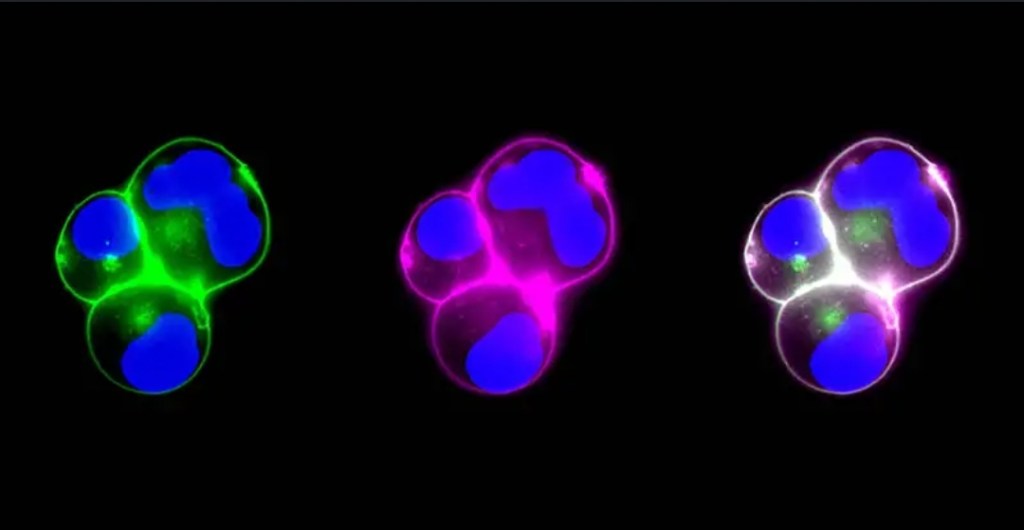
Live cell fluorescent visualization of biological molecules binding to the surface of genetically modified cell membranes, which serve as the coating for the modular nanoparticles. Credit: Zhang lab/UC San Diego Jacobs School of Engineering

Engineers at the University of California San Diego have developed modular nanoparticles that can be easily customized to target different biological entities such as tumors, viruses or toxins. The surface of the nanoparticles is engineered to host any biological molecules of choice, making it possible to tailor the nanoparticles for a wide array of applications, ranging from targeted drug delivery to neutralizing biological agents.

The beauty of this technology lies in its simplicity and efficiency. Instead of crafting entirely new nanoparticles for each specific application, researchers can now employ a modular nanoparticle base and conveniently attach proteins targeting a desired biological entity.

In the past, creating distinct nanoparticles for different biological targets required going through a different synthetic process from start to finish each time. But with this new technique, the same modular nanoparticle base can be easily modified to create a whole set of specialized nanoparticles.

„This is a plug and play platform technology that allows for rapid modification of a functional biological nanoparticle,“ said Liangfang Zhang, a professor of nanoengineering at the UC San Diego Jacobs School of Engineering.

Zhang and his team detail their work in a paper, titled „A modular approach to enhancing cell membrane-coated nanoparticle functionality using genetic engineering,“ published Oct. 30 in Nature Nanotechnology.

The modular nanoparticles consist of biodegradable polymer cores coated with genetically modified cell membranes. The key to their modular design is a pair of synthetic proteins, known as SpyCatcher and SpyTag, that are specifically designed to spontaneously—and exclusively—bind with each other. This pair is commonly used in biological research to combine various proteins.

In this study, Zhang and his team harnessed the pair to create a system for attaching proteins of interest to a nanoparticle surface with ease.

Here’s how it works: SpyCatcher is embedded onto the nanoparticle surface, while SpyTag is chemically linked to a protein of interest, such as one targeting tumors or viruses. When SpyTag-linked proteins come into contact with SpyCatcher-decorated nanoparticles, they readily bind to each other, enabling proteins of interest to be effortlessly attached to the nanoparticle surface.

For example, to target tumors, SpyTag can be linked to a protein designed to seek out tumor cells, and that SpyTag-linked protein is then attached to the nanoparticle. If the target shifts to a specific virus, the process is similarly straightforward: simply link SpyTag to a protein targeting the virus and attach it to the nanoparticle surface.


„It’s a very simple, streamlined and straightforward approach to functionalizing nanoparticles for any biological application,“ said Zhang.

To create the modular nanoparticles, the researchers first genetically engineered human embryonic kidney (HEK) 293 cells—a commonly used cell line in biological research—to express SpyCatcher proteins on their surface. The cell membranes were then isolated, broken into smaller pieces, and coated onto biodegradable polymer nanoparticles.

These nanoparticles were subsequently mixed with SpyTag-linked proteins. In this study, the researchers used two different proteins: one targeting the epidermal growth factor receptor (EGFR) and the other targeting human epidermal growth factor receptor 2 (HER2), both of which are prevalent on the surface of various cancer cells.

As a proof of concept, the researchers tested these nanoparticles in mice with ovarian tumors. The nanoparticles were loaded with docetaxel, a chemotherapy medication, and administered to mice via intravenous injection every three days for a total of four injections. Treatment with these nanoparticles suppressed tumor growth while improving survival rate. Treated mice had median survival of 63 to 71 days, while the median survival of untreated mice was 24 to 29 days.

The researchers are looking to further improve the modular nanoparticle platform for targeted drug delivery.

In addition to cancer treatment, Zhang is excited about other potential applications of this technology. „Because we have a modular nanoparticle base, we can easily attach a neutralizing agent on the surface to neutralize viruses and biological toxins,“ he said.

„There is also potential for creating vaccines by attaching an antigen on the nanoparticle surface using this modular platform. This opens the door to a variety of new therapeutic approaches.“

Researchers find gravitational lensing has significant effect on cosmic birefringence

by Kavli Institute for the Physics and Mathematics of the Universe, The University of Tokyo
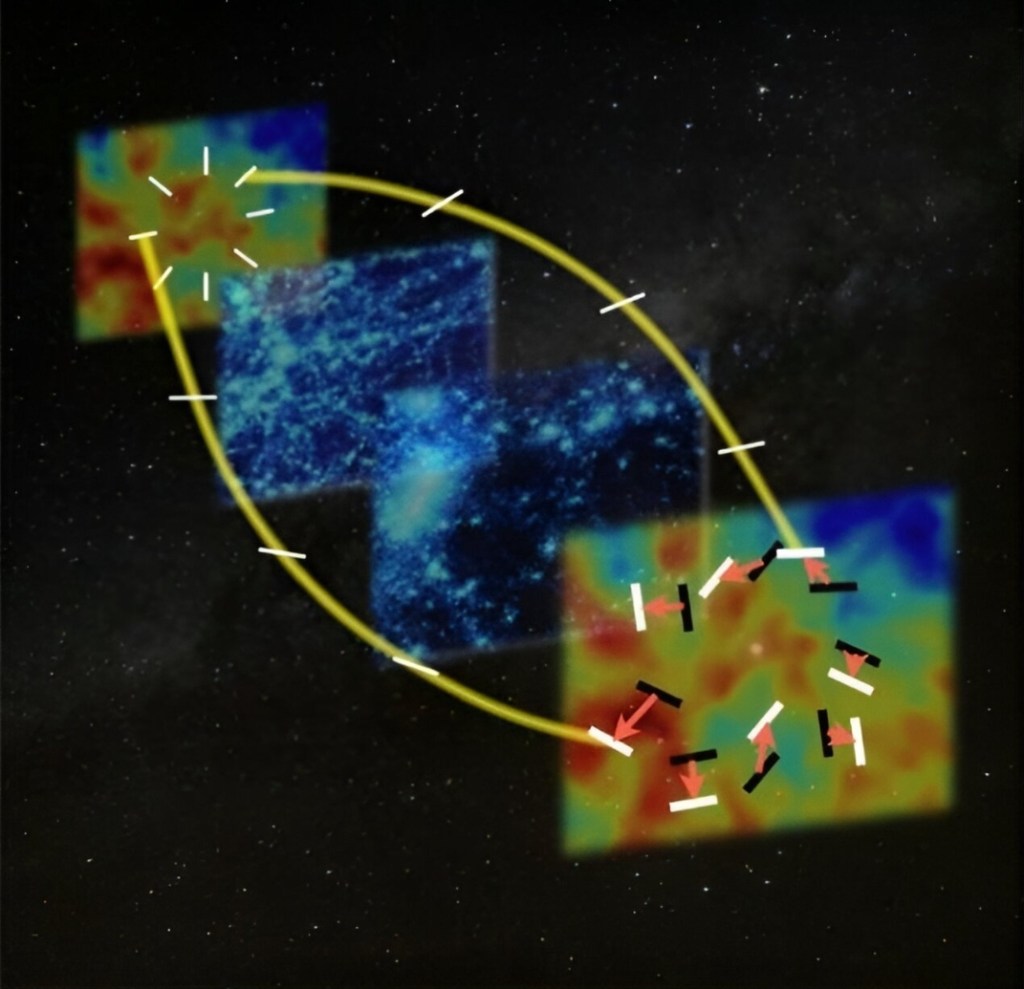
Cosmic Microwave Background (CMB) polarized light subjected to gravitational lensing effects, in addition to cosmic birefringence. On the far left, the white lines show the polarization pattern of the CMB light generated in the early universe. These rotate due to cosmic birefringence, resulting in the currently observed CMB depicted by the black lines on the right side of the image. However, the path of light is bent by the gravitational distortion of space-time created by the large-scale structure in the middle, and so the white lines showing the polarization pattern on the right side of the image shows what is observed. Credit: Physical Review D (2023). DOI: 10.1103/PhysRevD.108.063525

Future missions will be able to find signatures of violating the parity-symmetry in the cosmic microwave background polarization more accurately after a pair of researchers has managed to take into account the gravitational lensing effect, reports a new study in Physical Review D, selected as an Editors‘ Suggestion.

How far does the universe extend? When and how did the universe begin? Cosmology has made progress in addressing these questions by providing observational evidence for theoretical models of the universe based on fundamental physics. The Standard Model of Cosmology is widely accepted by researchers today. However, it still cannot explain fundamental questions in cosmology, including dark matter and dark energy.

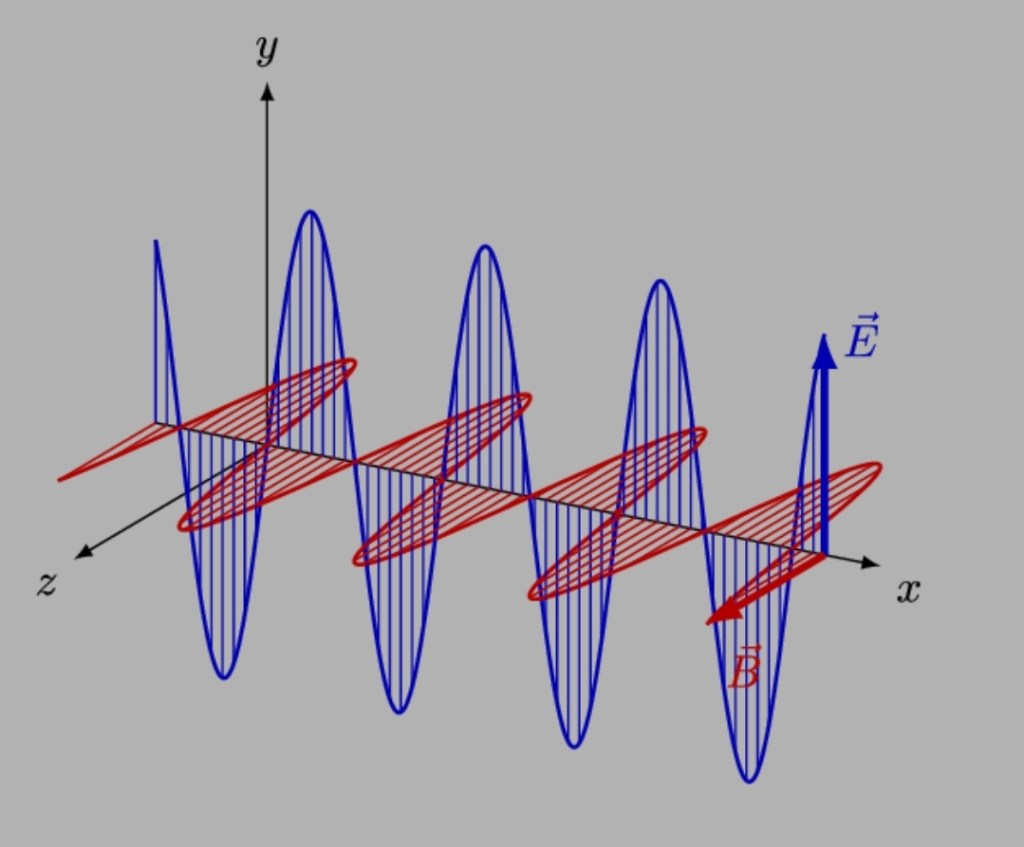
In 2020, an interesting new phenomenon called cosmic birefringence was reported from the cosmic microwave background (CMB) polarization data. Polarization describes light waves oscillating perpendicularly to the direction it is traveling. In general, the direction of polarization plane remains constant, but can be rotated under special circumstances.

A reanalysis of the CMB data showed the polarization plane of the CMB light may have slightly rotated between the time it was emitted in the early universe and today. This phenomenon violates the parity symmetry and is called the cosmic birefringence.

Because cosmic birefringence is challenging to explain with the well-known physical laws, there is a strong possibility that yet to be discovered physics, such as the axionlike particles (ALPs), lies behind it. A discovery of cosmic birefringence could lead the way to revealing the nature of dark matter and dark energy, and so future missions are focused on making more precise observations of the CMB.

A new study by a pair of researchers, led by The University of Tokyo Department of Physics and Research Center for Early Universe doctoral student Fumihiro Naokawa, and Center for Data-Driven Discovery and Kavli Institute for the Physics and Mathematics of the Universe (Kavli IPMU) Project Assistant Professor Toshiya Namikawa, established a theoretical calculation of cosmic birefringence that incorporates gravitational lensing effects, and worked on the development of a numerical code for cosmic birefringence that includes gravitational lensing effects, which will be indispensable for future analyses.

First, Naokawa and Namikawa derived an analytical equation describing how the gravitational lensing effect changes the cosmic birefringence signal. Based on the equation, the researchers implemented a new program to an existing code to compute the gravitational lensing correction, and then looked at the difference in signals with and without the gravitational lensing correction.

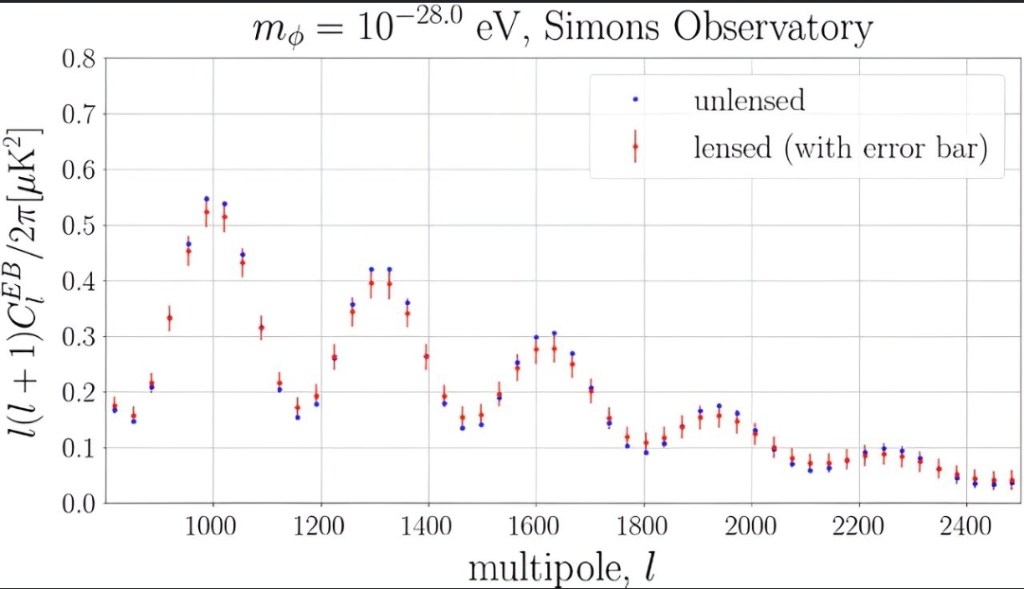
The difference in the cosmic birefringence signal with and without gravitational lensing. The blue dots show the signals when the gravitational lensing effect is ignored, and the red dots are the signals when the gravitational lensing effect is considered. The red error bars show the expected observation errors when the Simons Observatory will be used. The difference with and without gravitational lensing is not negligible. Credit: Physical Review D (2023). DOI: 10.1103/PhysRevD.108.063525

As a result, the researchers found that if gravitational lensing is ignored, the observed cosmic birefringence signal cannot be fitted well by the theoretical prediction, which would statistically reject the true theory.

In addition, the pair created simulated observational data that will be obtained in future observations to see the effect of gravitational lensing in the search for ALPs. They found that if the gravitational lensing effect is not considered, there would be statistically significant systematic biases in the model parameters of ALPs estimated from the observed data, which would not accurately reflect the ALPs model.

The gravitational lensing correction tool developed in this study is already being used in observational studies today, and Naokawa and Namikawa will continue to use it to analyze data for future missions.

What is an attosecond? A physical chemist explains the tiny time scale behind Nobel Prize-winning research


How long is an attosecond, and what can these infinitesimally short pulses tell researchers about the nature of matter?
Work in attosecond physics has led to a better understanding of how electrons move around. (Image credit: Oselote/iStock via Getty Images)

A group of three researchers earned the 2023 Nobel Prize in physics for work that has revolutionized how scientists study the electron – by illuminating molecules with attosecond-long flashes of light. But how long is an attosecond, and what can these infinitesimally short pulses tell researchers about the nature of matter?

I first learned of this area of research as a graduate student in physical chemistry. My doctoral adviser’s group had a project dedicated to studying chemical reactions with attosecond pulses. Before understanding why attosecond research resulted in the most prestigious award in the sciences, it helps to understand what an attosecond pulse of light is.

How long is an attosecond?

“Atto” is the scientific notation prefix that represents 10-18, which is a decimal point followed by 17 zeroes and a 1. So a flash of light lasting an attosecond, or 0.000000000000000001 of a second, is an extremely short pulse of light.

Previously, scientists could study the motion of heavier and slower-moving atomic nuclei with femtosecond (10-15) light pulses. One thousand attoseconds are in 1 femtosecond. But researchers couldn’t see movement on the electron scale until they could generate attosecond light pulses – electrons move too fast for scientists to parse exactly what they are up to at the femtosecond level.

Attosecond pulses

The rearrangement of electrons in atoms and molecules guides a lot of processes in physics, and it underlies practically every part of chemistry. Therefore, researchers have put a lot of effort into figuring out how electrons are moving and rearranging.

However, electrons move around very rapidly in physical and chemical processes, making them difficult to study. To investigate these processes, scientists use spectroscopy, a method of examining how matter absorbs or emits light. In order to follow the electrons in real time, researchers need a pulse of light that is shorter than the time it takes for electrons to rearrange.

As an analogy, imagine a camera that could only take longer exposures, around 1 second long. Things in motion, like a person running toward the camera or a bird flying across the sky, would appear blurry in the photos taken, and it would be difficult to see exactly what was going on.

Then, imagine you use a camera with 1 millisecond exposure. Now, motions that were previously smeared out would be nicely resolved into clear and precise snapshots. That’s how using the attosecond scale, rather than the femtosecond scale, can illuminate electron behaviour.

Attosecond research

So what kind of research questions can attosecond pulses help answer?

For one, breaking a chemical bond is a fundamental process in nature where electrons that are shared between two atoms separate out into unbound atoms. The previously shared electrons undergo ultrafast changes during this process, and attosecond pulses made it possible for researchers to follow the real-time breaking of a chemical bond.

Exploring Quantum Superposition: Unveiling the Enigmatic Nature of Reality

A illustrated picture eich shows how a partical/ object cam exist on two places at the same place

Welcome to Project Event Horizon, where we embark on a journey into the mind-bending world of quantum mechanics. In this article, we will delve into the intriguing concept of quantum superposition, a fundamental principle that challenges our classical understanding of reality. Prepare to have your mind expanded as we explore the mysterious nature of particles existing in multiple states simultaneously.

Unveiling Quantum Superposition:
Quantum superposition is a phenomenon that arises from the principles of quantum mechanics. At the quantum level, particles such as electrons or photons can exist in a state of superposition, where they simultaneously occupy multiple states or locations until measured or observed. This fascinating concept suggests a fundamental duality, blurring the boundaries between classical notions of particles and waves.

The Wavefunction and Superposition:
In quantum mechanics, particles are described by wavefunctions, which mathematically represent the probabilities of different states. A wavefunction can be understood as a combination of various possibilities, each with an associated probability amplitude. These possibilities can correspond to different positions, energies, or other measurable properties of the particle.

When a particle is in a superposition of states, its wavefunction encompasses multiple possibilities. For example, an electron can be in a superposition of being in two different positions simultaneously. This implies that the electron does not have a well-defined position until it is measured, as it can be thought of as existing in a smeared-out state of potentialities.

The Measurement Problem and Wavefunction Collapse:
The act of measurement or observation brings about a remarkable change in the behavior of a quantum system. When a measurement is made, the particle’s wavefunction undergoes a process called wavefunction collapse. This collapse causes the particle to be „chosen“ or „found“ in a specific state or location, with all other possibilities fading away.

The exact nature of wavefunction collapse is still a subject of debate and interpretation within quantum mechanics. Several interpretations, such as the Copenhagen interpretation or the many-worlds interpretation, offer different explanations and philosophical perspectives on how wavefunction collapse occurs.

Experimental Evidence:
Quantum superposition and wavefunction collapse have been experimentally verified in numerous experiments. One famous example is the double-slit experiment, where particles, such as electrons or photons, exhibit wave-like properties. When fired through two slits, they create an interference pattern on a screen, suggesting their simultaneous existence as waves passing through both slits. However, upon measurement or observation, they behave like particles, appearing as distinct points on the screen.

Implications and Applications:
The existence of quantum superposition has profound implications for our understanding of reality. It challenges our classical intuition and expands our perspective on the fundamental nature of particles. Quantum superposition also forms the basis for quantum computing, where the ability of quantum bits (qubits) to exist in superpositions enables exponentially increased computational power.


Conclusion:
Quantum superposition is a captivating concept that challenges our perception of reality. It reveals a mysterious world where particles can exist in multiple states or locations simultaneously until measured or observed. Through ongoing research and experimentation, scientists continue to unlock the secrets of quantum mechanics, pushing the boundaries of our understanding and paving the way for exciting technological advancements.

At Project Event Horizon, we invite you to delve deeper into the enigmatic realm of quantum mechanics, where the extraordinary becomes ordinary, and reality dances to the tune of uncertainty. Join us as we uncover the mysteries of the universe, one quantum leap at a time.

Exploring the Enigmatic Symphony: Unraveling the Mysteries of Galaxy Black Hole Noise

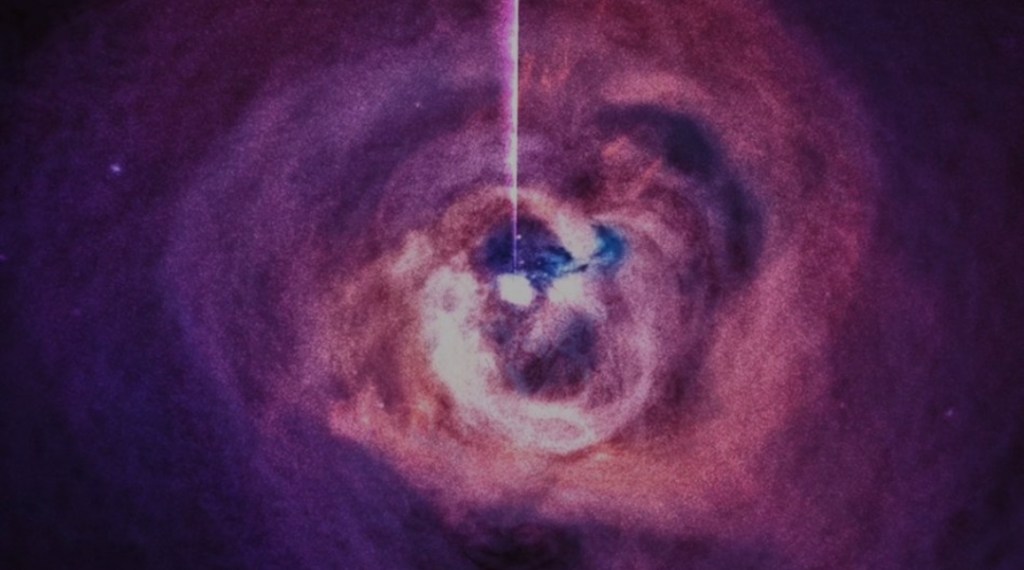
black hole at the centre of the Perseus galaxy cluster into notes audible to humans. The sound waves were extracted along the radius of the galaxy, outwards from its centre, and were transformed into the range of human hearing by scaling them upward by 57 and 58 octaves above their true pitch. Topics: black hole.

In the vastness of space, where celestial bodies dance in harmony, the enigmatic phenomenon of black holes captivates the imagination of scientists and stargazers alike. Among the many fascinating aspects of black holes, one peculiar feature has recently piqued the interest of researchers – the phenomenon known as „galaxy black hole noise.“ In this article, we delve into the depths of this cosmic symphony, exploring its origins, characteristics, and the remarkable insights it offers into the nature of black holes.

The Symphony of Galaxy Black Hole Noise:
When we think of sound, we often associate it with air or other physical mediums carrying vibrations. However, in the vast vacuum of space, sound waves as we perceive them on Earth cannot propagate. Instead, scientists use a different definition of „sound“ to describe certain phenomena occurring in space, including black hole noise.

Galaxy black hole noise refers to the characteristic emission of electromagnetic radiation and particles from black holes situated at the center of galaxies. This emission spans a wide range of wavelengths, from radio waves to gamma rays, and produces a diverse array of signals that can be detected by telescopes and other astronomical instruments. The „noise“ aspect comes from the unpredictable and fluctuating nature of these emissions, resembling the random fluctuations one would encounter in an audio soundscape.

Understanding the Origins:
The origin of galaxy black hole noise lies in the dynamic and turbulent environment surrounding supermassive black holes, which reside at the centers of most galaxies, including our own Milky Way. These colossal gravitational monsters, with masses millions or even billions of times that of our Sun, interact with their surroundings in complex ways, giving rise to a symphony of emissions.

One of the primary contributors to black hole noise is the accretion disk—a swirling disk of gas and dust that spirals towards the black hole due to its immense gravitational pull. As matter falls into the black hole, it heats up, emitting radiation across the electromagnetic spectrum. Additionally, high-energy particles are accelerated and ejected from the vicinity of the black hole, producing jets that emit powerful radiation. These processes, along with others that are still not fully understood, generate the diverse signals comprising the cosmic symphony of black hole noise.

Unveiling the Mysteries:
Studying galaxy black hole noise provides astronomers with invaluable insights into the properties and behavior of black holes. By analyzing the emitted signals, scientists can deduce various characteristics of black holes, such as their mass, spin, and the dynamics of their accretion disks. They can also study the interplay between black holes and their host galaxies, shedding light on the mechanisms that shape and regulate the growth of galaxies over cosmic timescales.

Moreover, black hole noise observations can reveal information about the environments surrounding these cosmic behemoths. By monitoring the fluctuations and patterns in the emitted signals, researchers can study the density, temperature, and composition of the gas and dust in the vicinity of black holes, offering clues about the overall structure and evolution of galactic nuclei.

The Future of Black Hole Symphony:
As technology advances and observational techniques improve, scientists are poised to delve deeper into the cosmic symphony of galaxy black hole noise. Upcoming missions and telescopes, such as the James Webb Space Telescope and the Square Kilometre Array, hold great promise for unraveling the remaining mysteries surrounding black holes and their emissions. By observing black holes across different wavelengths with unprecedented sensitivity, these future endeavors will open new avenues for exploration, enabling us to decipher the complex composition and dynamics of these cosmic powerhouses.

Conclusion:
Galaxy black hole noise presents a fascinating soundscape of emissions that holds profound implications for our understanding of the universe. Through meticulous observations and sophisticated analysis, scientists continue to

decode the symphony, revealing the secrets of black holes and their influence on the cosmos. With each new discovery, we move closer to unraveling the mysteries that lie at the heart of these cosmic enigmas, further expanding our knowledge of the universe we call home.

Hire is a short audio of how the Blackhole in the centre of the Perseus galaxy cluster
sounds like

The Mysteries of Dark Matter: Unraveling the Invisible Universe

The universe is filled with enigmas, and one of its most perplexing mysteries is the existence of dark matter. Despite its invisibility, dark matter is believed to make up a significant portion of our cosmos. In this article, we will explore the concept of dark matter, its role in shaping the universe, ongoing research efforts, and the unanswered questions that continue to fascinate astronomers and scientists.

1. What is Dark Matter?
Dark matter refers to a hypothetical form of matter that does not emit, absorb, or reflect light. Unlike the ordinary matter we encounter every day, such as stars, planets, and galaxies, dark matter does not interact with electromagnetic radiation. Its presence is inferred indirectly through its gravitational effects on visible matter.

2. The Evidence for Dark Matter:
Scientists have gathered compelling evidence for the existence of dark matter through various observations and measurements. Galactic rotation curves, gravitational lensing, and the distribution of matter on large scales are some of the phenomena that have indicated the presence of dark matter.

3. Dark Matter and the Structure of the Universe:
Dark matter plays a crucial role in the formation and evolution of the universe’s large-scale structure. It provides the gravitational scaffolding around which visible matter congregates, enabling the formation of galaxies, galaxy clusters, and cosmic web-like structures. Without dark matter, the observed structure of the universe would be vastly different.

4. The Search for Dark Matter:
Numerous experiments and observatories worldwide are dedicated to unraveling the nature of dark matter. Particle accelerators, underground detectors, and space-based telescopes are employed to directly or indirectly detect dark matter particles or study their effects. Prominent experiments, such as the Large Hadron Collider (LHC) and the Dark Energy Survey (DES), are at the forefront of this research.

5. Dark Matter Candidates:
While the exact composition of dark matter remains unknown, several candidates have been proposed. Weakly Interacting Massive Particles (WIMPs) and Axions are among the leading contenders. Scientists are actively conducting experiments to detect and study these elusive particles, aiming to shed light on their properties and interactions with ordinary matter.

6. The Quest for Answers:
Despite significant progress in dark matter research, fundamental questions remain unanswered. What is the precise nature of dark matter? How does it interact with other particles? Why does it vastly outnumber visible matter in the universe? Solving these puzzles could revolutionize our understanding of the cosmos and potentially reshape the laws of physics.


Conclusion:
Dark matter remains one of the most compelling and tantalizing mysteries of modern astrophysics. Its invisible presence and gravitational influence have shaped the universe as we know it. With ongoing research and technological advancements, scientists are inching closer to deciphering the secrets of dark matter, ultimately leading to a deeper comprehension of the cosmos and our place within it.

Remember to cite and credit any sources you use to maintain the accuracy and credibility of the article. Feel free to modify and expand upon this article as needed for your website.

Die Maximale und Minimale Physikalische Erwärmung: Einblicke in extreme Temperaturbereiche

Die physikalische Erwärmung ist ein Phänomen, das in verschiedenen Bereichen der Wissenschaft und Technik von großer Bedeutung ist. Sowohl in der Natur als auch in technischen Anwendungen gibt es extreme Temperaturbereiche, die sowohl für die Forschung als auch für die Praxis von Interesse sind. In diesem Artikel werfen wir einen Blick auf die maximale und minimale physikalische Erwärmung und untersuchen ihre Auswirkungen auf verschiedene Bereiche.

Maximale physikalische Erwärmung:
Die maximale physikalische Erwärmung bezieht sich auf den höchsten Temperaturbereich, der in einem bestimmten System oder Phänomen erreicht werden kann. In der Physik gibt es verschiedene Situationen, in denen extreme Temperaturen auftreten können. Ein Beispiel dafür ist das Experiment mit Hochenergie-Teilchenbeschleunigern wie dem Large Hadron Collider (LHC), bei dem Temperaturen erreicht werden können, die vergleichbar mit den Bedingungen kurz nach dem Urknall sind. In solchen Situationen werden die physikalischen Eigenschaften der Materie unter extremen Bedingungen untersucht.

Minimale physikalische Erwärmung:
Die minimale physikalische Erwärmung bezieht sich auf den niedrigsten Temperaturbereich, der in einem System erreicht werden kann. In der Wissenschaft wird oft der absolute Nullpunkt als Referenzpunkt für die minimale Temperatur verwendet. Der absolute Nullpunkt liegt bei 0 Kelvin (-273,15 Grad Celsius) und entspricht der niedrigsten Temperatur, bei der alle Bewegung von Teilchen aufgehört hat. Bei Temperaturen nahe dem absoluten Nullpunkt treten Phänomene wie Supraleitung und Bose-Einstein-Kondensation auf, die für verschiedene technologische Anwendungen von großer Bedeutung sind, wie zum Beispiel bei der Entwicklung von supraleitenden Magneten oder ultraschnellen Computern.

Auswirkungen und Anwendungen:
Die extremen Temperaturbereiche der physikalischen Erwärmung haben sowohl theoretische als auch praktische Auswirkungen. In der theoretischen Physik helfen sie dabei, fundamentale Eigenschaften der Materie zu erforschen und zu verstehen. In der technologischen Anwendung spielen sie eine wichtige Rolle bei der Entwicklung neuer Materialien, der Verbesserung von Energieeffizienz und der Erforschung neuer Technologien wie Quantencomputern.


Die maximale und minimale physikalische Erwärmung repräsentieren extreme Temperaturbereiche, die in verschiedenen Bereichen der Wissenschaft und Technik von Bedeutung sind. Von der Erforschung des Universums bis hin zur Entwicklung neuer Materialien und Technologien sind diese extremen Temperaturen entscheidend, um die Grenzen unseres Verständnisses zu erweitern und innovative Lösungen zu finden. Durch fortgesetzte Forschung und technologische Fortschritte werden wir hoffentlich noch tiefer in diese extremen Temperaturbereiche vordringen können und das Potenzial nutzen, das sie bieten.

Australian Physicists Have Proved That Time Travel is Possible

Scientists from the University of Queensland have used photons, which are single particles of light, to simulate quantum particles moving through time. The research is state-of-the-art, and the results could be big!

The research is state-of-the-art, and the results could be big! Their research, called “Experimental simulation of closed time-like curves,” is in the latest issue of Nature Communications.

The grandfather paradox says that if a person went back in time, he could accidentally stop his grandparents from meeting, which would mean that he would never be born. But if he hadn’t been born, he wouldn’t have been able to go back in time at all.

Einstein’s theory of relativity and the solution to it, the Godel metric, are mostly to blame for the paradoxes. What makes relativity work There are two parts to Einstein’s theory of relativity: general relativity and special relativity. Special relativity says that space and time are both parts of the same thing, which is called the “space-time continuum,” and that time can slow down or speed up depending on how fast you are moving relative to something else.

Gravity can also bend time, and Einstein’s theory of general relativity suggests that it would be possible to go back in time by following a space-time path, which is a closed time-line curve that returns to the starting point in space, but at an earlier time. In 1991, it was thought that quantum mechanics could solve some of the problems caused by Einstein’s theory of relativity. This is because quantum particles almost act like they don’t belong in physics.


“The question of time travel is at the intersection of Einstein’s theory of general relativity and quantum mechanics, which are two of the best physical theories we have but don’t agree with each other. Einstein’s theory describes the world on a very large scale, like stars and galaxies. Quantum mechanics, on the other hand, is a great way to describe the world on a very small scale, like atoms and molecules. Martin Ringbauer, who is getting his PhD at UQ’s School of Mathematics and Physics and is the paper’s lead author, said this.

In two different situations, the scientists tried to model how two photons would act when they came into contact with each other. In the first case, one photon went through a wormhole and then talked to an older version of itself. In the second case, a photon moves through normal space-time and interacts with another photon that is stuck inside a closed time-line curve forever.

“Quantum particles have “fuzzy” or uncertain properties to begin with, so this gives them enough wiggle room to avoid time travel situations that don’t make sense,” said Professor Timothy Ralph, who was also a co-author on the paper. “Our research shows where and how nature might act differently than what our theories say it should,” Small quantum particles have been used to simulate time travel, but it may not be possible to do the same with bigger particles or atoms, which are groups of particles.

The research has been published in the journal Classical and Quantum Gravity.

Scientists Discover Thousands of Previously Unknown Volcanoes on Venus

Thousands more volcanoes hide beneath this cloudy surface than previously thought. Photo: NASA/JPL-Caltech

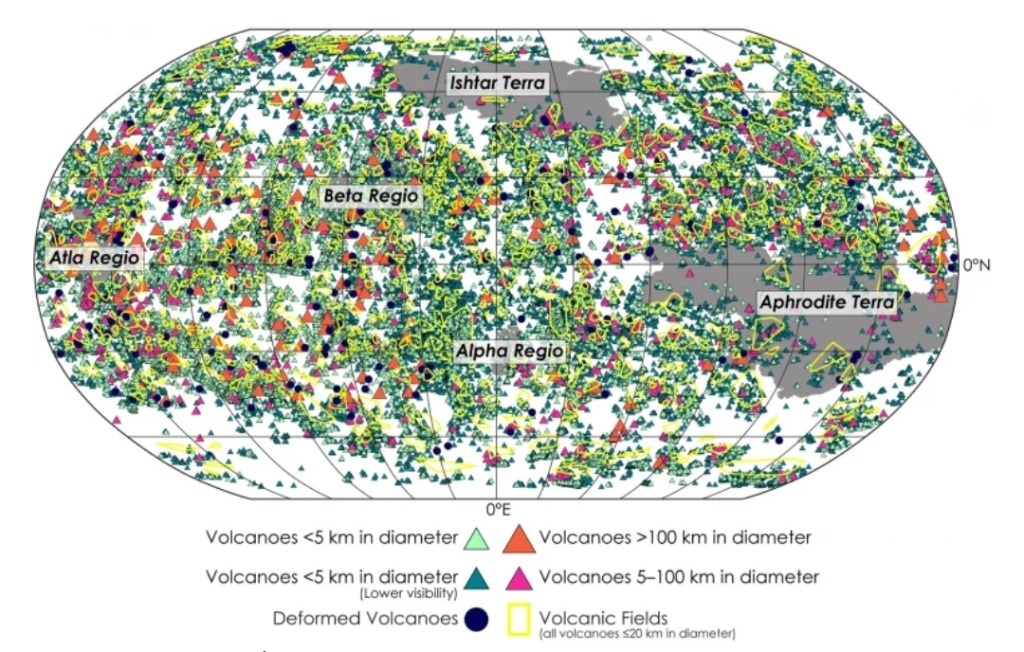
Scientists using new methods to analyze decades-old data from the Magellan spacecraft have revealed 50 times more volcanoes on Venus than previously thought. The paper, published in the journal JGR Planets, brings the total number of volcanoes on the second planet to over 85,000.

Planetary scientists Rebecca M. Hahn and Paul K. Bryne discovered that most of the volcanoes on Venus are under five kilometers in diameter and are unmapped. Their paper’s abstract points out that these small volcanoes dotted “virtually the entire planet.”

“We [now] have a better handle of how many volcanoes are on Venus than are on Earth,” Byrne told Science News.

That’s because Earth’s oceans and trees tend to hide non-active volcanoes, particularly small ones. Venus, of course, has none of those things.

It took improved technology and a pair of dedicated scientists to comb through the Magellan imagery and pick the small volcanoes out of the visual clutter on the planet’s surface.

Scientists working on upcoming NASA and ESA missions to Venus could use this map to discover recent volcanic activity. Map: R. HAHN AND P. BYRNE/JGR PLANETS 2023

The ancient past meets the near future

While the number of total volcanoes on Venus far outstrips those found on Earth, the number of currently active volcanoes on the second planet is unknown and is likely to be very small. By contrast, the United States Geological Survey pegs the number of active volcanoes on Earth at 1,350. It’s a matter of plate tectonics, which the Earth has, but Venus doesn’t (at least not in the same way).

But our lack of knowledge about currently active Venusian volcanoes could soon change. Using the same Magellan imagery as the scientists in this story, a different team of researchers discovered evidence of recent volcanic activity on Venus. And with Hahn and Bryne’s new map, the teams running forthcoming NASA and European Space Agency Venus missions might know where to point the spacecraft’s sensitive equipment.