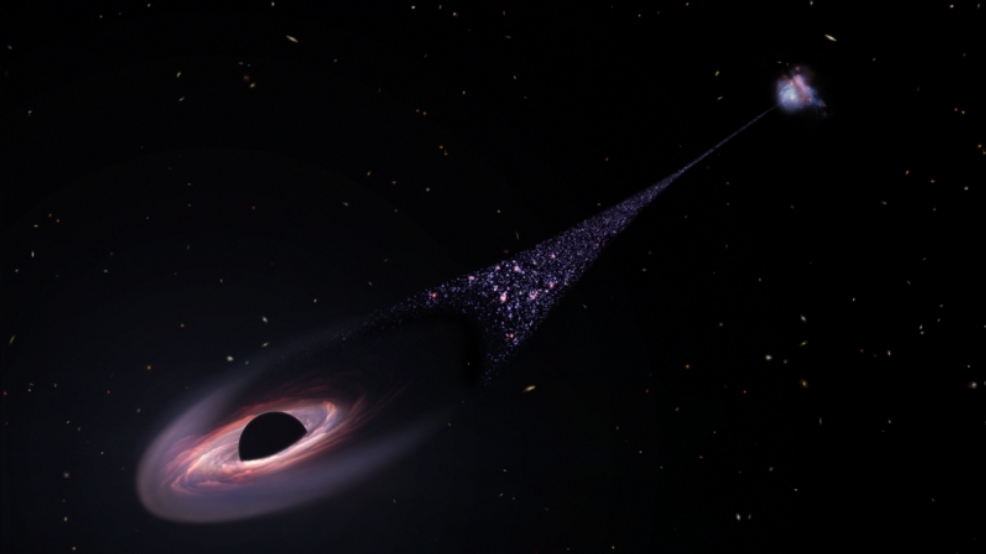
Astronomers accidentally discovered with the Hubble Space Telescope a runaway black hole doing weird, unprecedented things. Credit: NASA / ESA / Leah Hustak (STScI) illustration
Astronomers think they have discovered a supermassive black hole traveling away from its home galaxy at 4 million mph — so fast it’s not doing what it’s notorious for: sucking light out of the universe.
Quite the opposite, possibly. Rather than ripping stars to shreds and swallowing up every morsel, this black hole is believed to be fostering new star formation, leaving a trail of newborn stars stretching 200,000 light-years through space. Pieter van Dokkum, an astronomy professor at Yale University, said as the black hole rams into gas, it seems to trigger a narrow corridor of new stars, where the gas has a chance to cool.
How exactly it works, though, isn’t known, said van Dokkum, who led research on the phenomenon captured by NASA’s Hubble Space Telescope accidentally. A paper on the findings(Opens in a new tab) was published last week in The Astrophysical Journal Letters.
“What we’re seeing is the aftermath,“ he said in a statement(Opens in a new tab). „Like the wake behind a ship, we’re seeing the wake behind the black hole.”
Black holes are some of the most elusive things in outer space. The most common kind, a stellar black hole(Opens in a new tab), is often thought to be the result of an enormous star dying in a supernova explosion. The star’s material then collapses onto itself, condensing into a relatively tiny area.
But how supermassive black holes(Opens in a new tab), millions to billions of times more massive than the sun, form is even more mysterious. Many astrophysicists and cosmologists believe these behemoths lurk at the center of virtually all galaxies. Recent Hubble Space Telescope observations have bolstered the theory that supermassive black holes get their start in the dusty cores of starburst galaxies, where new stars are rapidly churned out, but scientists are still trying to get to the bottom of it.
Black holes don’t have surfaces, like on a planet or star. Instead, they have a boundary called an „event horizon(Opens in a new tab)„—it’s a point of no return. Generally, if anything swoops too close, it will fall in, never to escape the hole’s gravitational pull. But this weird black hole may be moving too fast to consume celestial objects as usual, defying the status quo.
 Project Event horizon