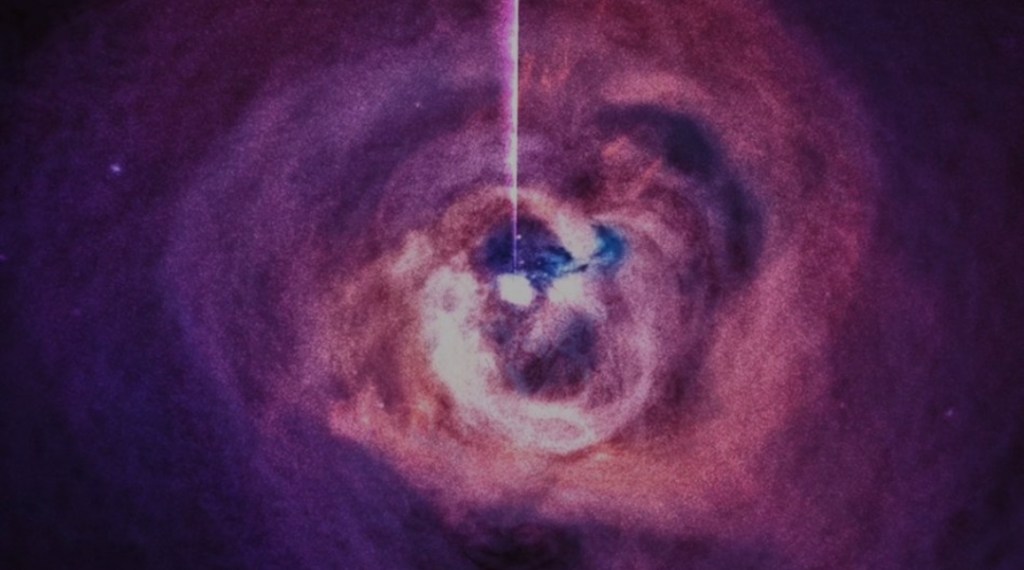
In the vastness of space, where celestial bodies dance in harmony, the enigmatic phenomenon of black holes captivates the imagination of scientists and stargazers alike. Among the many fascinating aspects of black holes, one peculiar feature has recently piqued the interest of researchers – the phenomenon known as „galaxy black hole noise.“ In this article, we delve into the depths of this cosmic symphony, exploring its origins, characteristics, and the remarkable insights it offers into the nature of black holes.
The Symphony of Galaxy Black Hole Noise:
When we think of sound, we often associate it with air or other physical mediums carrying vibrations. However, in the vast vacuum of space, sound waves as we perceive them on Earth cannot propagate. Instead, scientists use a different definition of „sound“ to describe certain phenomena occurring in space, including black hole noise.
Galaxy black hole noise refers to the characteristic emission of electromagnetic radiation and particles from black holes situated at the center of galaxies. This emission spans a wide range of wavelengths, from radio waves to gamma rays, and produces a diverse array of signals that can be detected by telescopes and other astronomical instruments. The „noise“ aspect comes from the unpredictable and fluctuating nature of these emissions, resembling the random fluctuations one would encounter in an audio soundscape.
Understanding the Origins:
The origin of galaxy black hole noise lies in the dynamic and turbulent environment surrounding supermassive black holes, which reside at the centers of most galaxies, including our own Milky Way. These colossal gravitational monsters, with masses millions or even billions of times that of our Sun, interact with their surroundings in complex ways, giving rise to a symphony of emissions.
One of the primary contributors to black hole noise is the accretion disk—a swirling disk of gas and dust that spirals towards the black hole due to its immense gravitational pull. As matter falls into the black hole, it heats up, emitting radiation across the electromagnetic spectrum. Additionally, high-energy particles are accelerated and ejected from the vicinity of the black hole, producing jets that emit powerful radiation. These processes, along with others that are still not fully understood, generate the diverse signals comprising the cosmic symphony of black hole noise.
Unveiling the Mysteries:
Studying galaxy black hole noise provides astronomers with invaluable insights into the properties and behavior of black holes. By analyzing the emitted signals, scientists can deduce various characteristics of black holes, such as their mass, spin, and the dynamics of their accretion disks. They can also study the interplay between black holes and their host galaxies, shedding light on the mechanisms that shape and regulate the growth of galaxies over cosmic timescales.
Moreover, black hole noise observations can reveal information about the environments surrounding these cosmic behemoths. By monitoring the fluctuations and patterns in the emitted signals, researchers can study the density, temperature, and composition of the gas and dust in the vicinity of black holes, offering clues about the overall structure and evolution of galactic nuclei.
The Future of Black Hole Symphony:
As technology advances and observational techniques improve, scientists are poised to delve deeper into the cosmic symphony of galaxy black hole noise. Upcoming missions and telescopes, such as the James Webb Space Telescope and the Square Kilometre Array, hold great promise for unraveling the remaining mysteries surrounding black holes and their emissions. By observing black holes across different wavelengths with unprecedented sensitivity, these future endeavors will open new avenues for exploration, enabling us to decipher the complex composition and dynamics of these cosmic powerhouses.
Conclusion:
Galaxy black hole noise presents a fascinating soundscape of emissions that holds profound implications for our understanding of the universe. Through meticulous observations and sophisticated analysis, scientists continue to
decode the symphony, revealing the secrets of black holes and their influence on the cosmos. With each new discovery, we move closer to unraveling the mysteries that lie at the heart of these cosmic enigmas, further expanding our knowledge of the universe we call home.
sounds like

 Project Event horizon